

The Signing Ceremony Everyone Saw. The Two Fights Nobody Announced.
What It Actually Takes to Land a Research Partnership With a Vietnamese University
GREEN ENERGY
Tu Nguyen
7/10/20263 min read
What It Actually Takes to Land a Research Partnership With a Vietnamese University
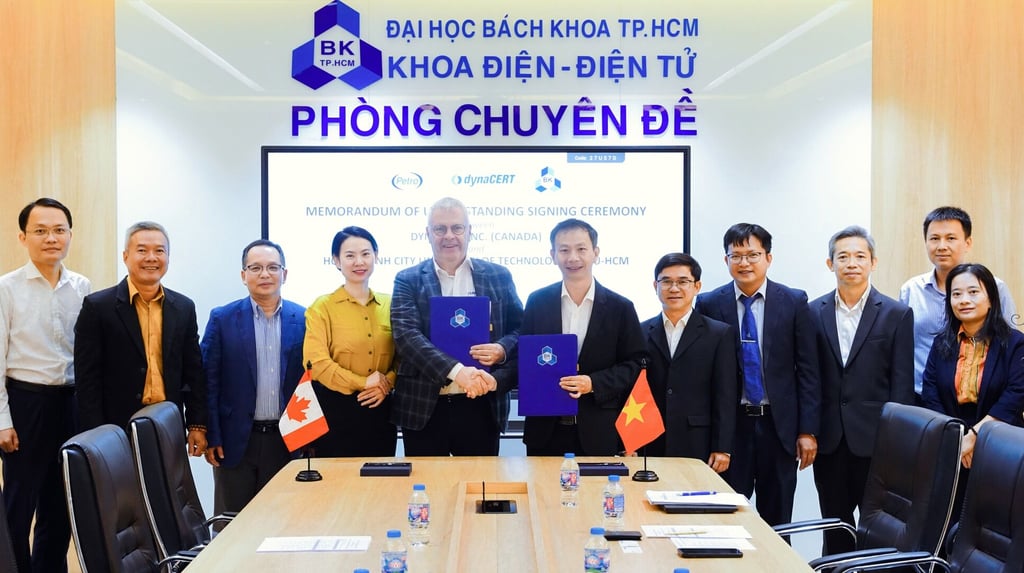
On April 21, 2026, dynaCERT Inc. and Ho Chi Minh City University of Technology signed a cooperation agreement to bring hydrogen combustion research onto campus. I was there, as PetroSouth's role was to get dynaCERT to that signing table as their trusted local partner in Vietnam. The announcement reads like a straight line from introduction to ceremony. It was not a straight line. Two things made it hard, and neither of them show up in a press release.
The first was that dynaCERT was not the only foreign company trying to get through that door. A university like HCMUT — VNU-HCM's flagship engineering school — is a magnet for every foreign cleantech, hydrogen, EV, and emissions-monitoring vendor looking for exactly the kind of credibility a signed MOU with a top Vietnamese institution provides. We were not pitching into a vacuum. We were one of several companies trying to get the attention of a small number of faculty and administrators who can only take on so many partnerships a year. Winning that slot was not about having the best technology. It was about being the proposal that made it easiest for the university to say yes before someone else's proposal did.
The second, and the harder one: dynaCERT's pitch, as it exists in the commercial world, does not work in a university boardroom. HydraGEN and HydraLytica are sold to fleet operators on a simple case — burn cleaner, use less fuel, cut emissions, see the number on your fuel bill drop. A university's Vice Rector does not buy fuel. He is evaluated on research output, published papers, and what his engineering students can put on a CV. We had to take a commercial retrofit product and rebuild the entire case around it: what thesis topics come out of a hydrogen-diesel combustion lab, what a joint research program publishes, what an internship pipeline into a Canadian technology company does for a graduating class. Same technology, completely different pitch, and the first version of that pitch — the one built for a fleet manager — went nowhere with the university until we threw it out and started over.
This is the piece Canadian companies miss when they hear "university partnership" and assume it is a simpler, softer version of a commercial deal. It is not softer. It is a different buyer with a different scorecard, and you are still competing for their limited attention against other vendors who understood that scorecard before you did. I have watched foreign companies walk into a university meeting with the same deck they use for a corporate buyer, get a warm reception, and never hear back — because a warm reception in an academic setting is not the same signal it is in a commercial one. Vietnamese academic institutions are polite to everyone. They sign MOUs with almost no one.
If you are a Canadian company looking at a university partnership in Vietnam as your entry point, budget time for two separate jobs: finding out who else is already courting that institution in your space, and building a second pitch deck from scratch that answers what faculty and students get, not what a customer saves. Skip either one and you get exactly what a lot of foreign vendors get: a friendly meeting, a group photo, and no signature.
The signing on April 21 was real, and I am glad to have helped get dynaCERT there. But the lesson for anyone chasing the same kind of partnership is not "build relationships and be patient." Every foreign company chasing a Vietnamese university already believes that. The lesson is: know you are in a competition you were never told you had entered, and know that the pitch that gets you a warm meeting is not the pitch that gets you a signature.
Working on a Vietnam market decision? Get in touch.